Fintech Software
A unified AP/AR automation system that replaces fragmented manual workflows with automated invoice processing, vendor reconciliation, and payment workflows
My role
UX Designer
Duration
11 weeks
Ongoing
Team
Tools
NDA
This project is under NDA, I cannot share it publicly. Reach out directly to walk through the full case study together.
What I did
I led the end-to-end design for the AP/AR platform by conducting deep discovery into existing financial workflows, identifying inefficiencies in reconciliation and invoice tracking, and restructuring the dashboard experience for faster resolution. The automated platform will replace 6+ fragmented manual workflow steps across QuickBooks, RO Writer, Excel and Vendor Portals - consolidating bookkeeping operations at scale.
About PABS
Pacific Accounting & Business Services, Inc. (PABS) provides financial management, accounting and operational support services to business across multiple industries. Their internal financial systems handle large volumes of transactions, invoices, and reconciliation processes across vendors and locations.
The AP/AR platform was designed to streamline these workflows by providing a centralized dashboard where finance teams can monitor transactions, reconcile invoices, identify discrepancies, and manage operational risks more efficiently.
Impact
To measure impact, I combined qualitative insights from stakeholder usability reviews with quantitative validation from prototyping experiments to track efficiency across reconciliation, invoice processing, and workflow completion
60%
Reduced Invoice Processing Time
3X
Improved Financial Visibility for Clients
45%
Reduced Error Rates in Data Extraction
What was the problem before?
Before this platform, PABS teams navigated 6+ disconnected systems daily — manually tracking invoices, reconciling vendor statements, and cross-verifying amounts across QuickBooks, Excel, RO Writer, and vendor portals
Fragmented Systems
Error-Prone Reconciliation
Cross-system amount verification relied on color-coded Excel highlighting, which is easy to miss and hard to audit
No Real-Time Visibility
Team had no live status indicators for pending payments, matched/unmatched bills, or deposit gaps leading to confusion
Slow Issue Detection
Operational issues such as duplicate bills, missing credits, or delayed payments were often discovered late in the process
Solution
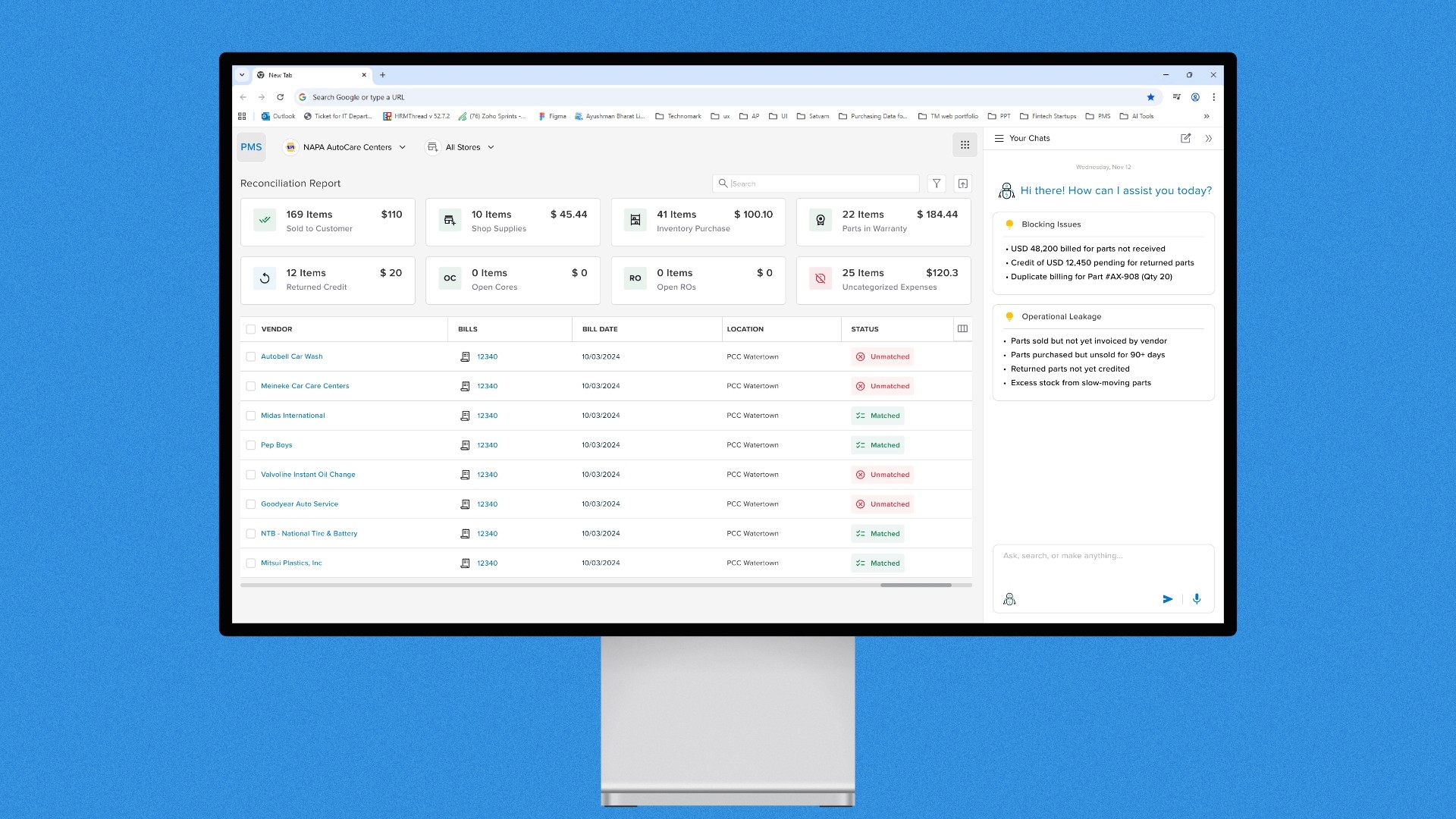
To address these challenges, the AP/AR automation platform focused on consolidation, real-time visibility, and intelligent exception management. It simplifies complex financial workflows through clear data organization, real-time status indicators, and intelligent insights that help finance teams quickly identify issues and take action
Centralized Financial Dashboard
Interface that consolidates invoices, reconciliation reports, and vendor data, allowing teams to monitor financial activity in one place
Smart Reconciliation Tracking
Clear status indicators to help users quickly identify matched, unmatched, and unresolved transactions without manual cross-checking
Operational Insights Panel
Key Learnings
Building for accounting teams taught me that great design isn't about adding smarter features, but it's about removing the friction that was never questioned before
Designing for Financial Accuracy
Small UI details like status indicators, color cues, and clear labels play a huge role in helping finance teams quickly detect mismatches and errors
Designing for Scale
Financial platforms must handle large volumes of transactions, so scalable tables, filters, and data views are critical for long-term usability
Reducing Cognitive Load
Liked my work?
LET’S CONNECT!
juhimodi1998@gmail.com
Based in USA
